
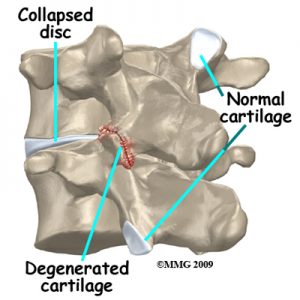
What is a Collapsed Disc?
A collapsed disc occurs when the discs of the spine lose their normal height over time due to disc degeneration or reduction of the fibrous outer wall and this can also happen because the natural aging process, spinal arthritis, or spinal injury and degenerative disc disease. these are the more common causes of a collapsed disc But if the disc starts to interfere with the surrounding nerves in the spine, this may lead to serious complications.
Collapsed Disc Causes
There are many causes contributing to a collapsed disc, a collapsed may occur :
Spinal arthritis , also known as osteoarthritis, this degenerative condition of the spine is due to aging
Sudden Injury: A serious injury caused by an auto accident, sports injury, or other type of serious injury can immediately cause a disc to collapse where there were previously no symptoms.
Symptoms of a collapsed disc
Most often a collapsed disc doesnt cause extreme symptoms,and it is rarely an isolated condition unless cause by an injury .
if you are experiencing the following please contact your orthopedic surgeon for more advice
Pain in the back that may radiate to the legs
Tingling or numbness in the back or extremities
Mobility or functional issues in the back
Bladder or bowel control issues
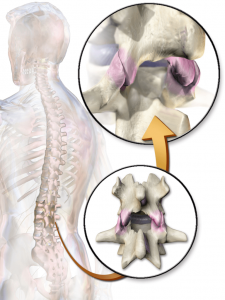 What’s a Facet Joint?
A pair of facet joints connects each vertebra to the one below it.
On the backside of most vertebrae is a bony structure called the vertebral arch. In its center is a bumpy projection – that’s the part you can feel as you run your fingers down the spine. This little knob sits at the center of the vertebral arch. Pairs of rigid projections extend upward and downward on either side.
A facet (fuh-SETT) joint is the point at which the downward projections of one vertebra meet the upward projections of the vertebra below it. Each facet joint is lined with cartilage and surrounded by a fluid-filled capsule that keeps the joint lubricated. Inside the capsule are tiny offshoots of the medial nerve, which relay pain signals to the brain when joint damage occurs.
What are Facet Joint Syndrome causes
The Spinal Column, the weight bearing portion of the spine is made up of flat, round vertebrae alternating with supportive discs. We wouldn’t get very far, though, if these structures were simply stacked up with no connection. These connecting points must be flexible enough for us conduct our normal day chaos like pick up toys from the living room floor to pulling weeds from our garden. That’s where the facet joint comes in.
Facet Joint Syndrome Symptoms
Facet joint syndrome can cause back pain, tenderness, inflammation, or stiffness at or near its site of origin. You might not be able to move or bend as freely as you used to. As the muscles surrounding the joint capsule work overtime to protect the compromised area, muscle spasms can also occur. The pain may travel outward from its source like an echo, causing headaches, neck stiffness, or pain in the shoulder, leg, buttocks, arm, or hand.
The pain usually occurs on one side of the body, and certain positions or movements, may intensify it. Although doctors sometimes recommend rest, long periods of inactivity ultimately aggravate the pain because the muscles that support the facet joints weaken if they’re not used.
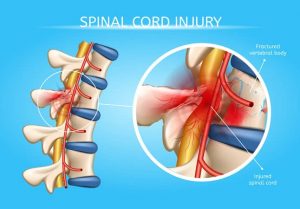
What Is a Spinal Fracture?
Your spine is composed of a series of arches that give it strength. However, just as any building can fall, any bone can break, and the vertebrae are no exception.
A typical vertebra is composed of a body, which is roughly the shape of a heart or a kidney, attached to a bony vertebral arch. Viewed from the top, it looks something like a crown. The vertebral arch and the back of the vertebral body together form a strong, protective ring around the spinal cord.
A vertebral fracture is a broken vertebra. Vertebral fractures fall into two broad categories: traumatic (associated with injury) and pathological (associated with disease or degeneration).
How Common Are Spinal Fractures?
Spinal (or vertebral) fractures are extremely common among older adults. One study places the incidence at one in six women and one in 12 men; however, most people dismiss their symptoms as being nothing more than normal aches and pains. .
Among older adults with osteoporosis, 700,000 vertebral fractures occur every year.
What Are the Symptoms of Spinal Fracture?
Bone tissue contains no nerve endings. Nevertheless, a vertebral fracture can be painful because the collapsed vertebra compresses surrounding structures that do have pain receptors. For example, a vertebral fracture can compromise the spinal canal, crowding the spinal cord and causing spinal stenosis and a kind of pain called myelopathy. Or the crumbling bone can compress a spinal nerve, creating a type of nerve pain called radiculopathy.
A vertebral fracture can also reduce range of motion and limit your ability to perform your daily activities. In many people, though, vertebral fracture produces no symptoms or only low-level pain.
Please consult a doctor if you think a fracture has occured
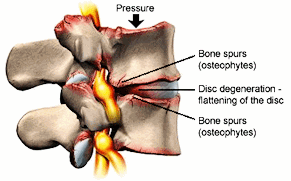
What is Degenerative Disc Disease?
Degenerative disc disease (DDD) is the deterioration of the discs in the spine , thus limiting the range of motion and produces chronic pain.
As we age, the disc’s cellular composition changes and it becomes less able to absorb kinetic energy. Its gel-like nucleus loses water content, and collagen fibers in the outer ring weaken. The disc loses height and may bulge or herniate into the spinal canal, compressing nearby nerves and causing persistent back pain. Because branches of these nerves provide sensation to the arms and legs, pain from DDD can radiate down the leg or into the arm.
Potential cause of Degenerative Disc Disease
Your spine is a robust and resilient structure made up of vertebral bones alternating with fibrous discs that continually absorb shock as you move. This shock, which is just a transfer of energy, is usually minimal. For instance, as a postal carrier walks their route, the spine absorbs kinetic energy with each step. But the spine can handle more intense forces when necessary, such as when a baggage handler lifts heavy pieces of luggage and heaves them into the belly of an aircraft.
Discs separate the vertebrae, absorbing shock and making the spine flexible.
What Are the Symptoms of Degenerative Disc Disease?
DDD can affect the cervical spine (neck), thoracic spine (midback), or lumbar spine (lower back).
For many people, DDD produces no symptoms. Those who do have symptoms most often report back pain. DDD pain is a type of radiculopathy. Those with cervical DDD may have pain in the arm, neck, or shoulder. Pain in those with lumbar DDD may extend into the buttocks, leg, or foot.